TS-New showing English updates from
V 2-17-06 to
V 4-16-06
Insertions in PINK
Deletions in PALE GREEN
We learned in Lynn's
story that she was born and raised as a boy, and later in
life was changed into a girl by female sex hormone treatments
and major surgical procedures. Because of this past, Lynn is
sometimes called a "transsexual" woman. Why did this
happen to Lynn, and what is transsexualism anyway?
In order to understand transsexualism, we must first answer
some basic questions about gender. What is Gender Identity? Where
does it come from? What events occur in nature that interfere
with correct assignments of gender? These pages aim at answering
these questions. Links are then provided to further information
on gender identity, transgenderism, transsexualism and intersexuality,
and to information about methods and technology for physical
gender modification.
Knowledge in this area is under rapid development. There
are challenges in defining, separating and "labeling"
the different phenomena, and in making estimates of frequencies
of occurrence. There are also differing interpretations of the
underlying science, and differing points of view about the evolving
social and medical protocols for resolving these conditions.
However, much more is known about gender identity than just
a few short years ago, and those new understandings are very
much worth sharing and building upon. The taboo on this area
has also been broken, so that we can openly discuss these important
issues without fear, shame or embarrassment.
As we'll see, far more people suffer from gender-identity
conditions than previously suspected, and the lives of millions
of people are impacted by gender-identity issues. The key to
improving the quality of those lives is better knowledge and
more widespread understanding of that knowledge.
ADDITIONAL REFERENCE WEBPAGES:
Part I - Contents:
|
GENDER BASICS: |
|
What makes us a boy or a girl?
What determines our gender identity? |
|
Intersex conditions - including
intersex babies whose gender is ambiguous at birth. |
|
The practice of "surgically
correcting" the genitals of intersex infants to make them
"normal". |
|
How these attempted "corrections"
reveal that old theories of gender identify formation were wrong. |
|
More lessons from intersex
people
about gender identity. |
|
The theory that gender identity
is socially constructed is finally shattered |
|
The theory that prenatally established
brain and CNS structures determine innate gender feelings. |
|
|
|
TRANSGENDERISM: |
|
Introduction |
|
Counseling and medical treatment
of transgender and transsexual women. |
|
Other conditions
overlapping with or often conflated
with transgenderism and transsexualism: |
|
Ex: Being gay, drag
queens, female impersonators, transvestites and crossdressers,
travestis,
fetishists, others. |
|
Why do some react to
transgender and transsexual people with such hostility? |
|
Shades of gray: Combinations
and intergradations of gender and partner-preference. |
|
Getting beyond "labels",
and thinking of gender feelings, gendered behaviors and gender
trajectories instead. |
|
Part I continued
- in Part Ia: |
|
ContrastingTransgender (TG) transitions and Transsexual
(TS) transitions. |
|
Rethinking discrimination and hate crimes against gay
and transgender people. |
|
Sadly, transphobia is also often projected by gays,
lesbians and feminists (and how that is changing now). |
|
The transgender kids who are run away or are"thrown
away". |
|
The transgender kids who are helped by their families. |
|
However, even those transgendered kids who are accepted
by their families face many dangers right now. |
|
Efforts at extending full human rights protections to
transgender people. |
|
Sketch of the differences in the situations of TG and
TS people in different countries around the world. |
|
The powerful role of the internet is now playing in
helping transgender and transsexual people. |
|
Hopes for the future. |
GENDER
BASICS:
Gender is the most fundamental part of one's identity as
a human being. The very first question everyone asks about us
is "Is it a boy or a girl?"
Important though it is, most people never think much about
gender. They have no idea what causes their sense of being a
boy or a girl, a man or a woman. Having never suffered mis-gendering,
they take their gender for granted like the air that they breathe,
never giving it a second thought. It is an unquestioned birth
privilege to have a gender.
Conventional wisdom says that people are either boys who
grow up to become men, or they are girls who grow up to become
women. There are only two possibilities, and you are either one
or the other. It's obvious at birth from your "genital sex",
and that's all there is to it! However, as we will see, reality
is not that simple.
What makes us a boy or a girl? What determines
our gender identity?
During early pregnancy, a fetus that has male genes (XY chromosomes)
usually develops into a boy with male genitals. It develops into
a girl with female genitals if it has female genes (XX chromosomes).
This happens well over 99% of the time. Doctors and parents look
at an infant's genitals at birth, and simply declare it to be
a boy or a girl.
Those declared to be boys usually grow up into men having
a male gender identity, and those declared to be girls usually
grow up into women having a female gender identity. Again, it
all seems pretty straightforward.
Although more than 5% of all men and women will grow up
to be gay, and will seek love partners of the same
sex and/or gender
as themselves, they too usually have normal male and female gender
identities as men and women, respectively.
Intersex conditions - including intersex babies whose
gender is ambiguous at birth:
Although most infants appear to be either normal boys or
normal girls, various genetic and developmental effects can lead
in some cases to infants having ambiguous genitalia, so that
even the doctors can't be sure whether it's a boy or a girl.
In other cases, the genitals look correct for one gender, but
aren't consistent with the infant's genes. In yet other cases
the child's genes are something more complex than just XX or
XY, and the child's gender identity and physical gender trajectory
as they mature may be difficult to predict in advance. Children
having these genital and/or genetic variations are called "intersex".
Intersex babies are produced in about one in every
1000 births.
For example, in about one in 13,000 births an XY (genetic
male) fetus is unresponsive to fetal male hormones, and develops
genitals that look like a girl's, except for a lack of internal
reproductive organs. These XY "complete androgen insensitivity
syndrome" (cAIS) infants are simply declared to be girls
and are raised as girls. Although they cannot bear children,
they often develop into slender, attractive women who have a
female gender identity. It's rumored that a number of beautiful
models have been cAIS girls.
In other births, a "partial androgen insensitivity syndrome"
(pAIS) results in the external genital appearance may lie anywhere
along the spectrum from male to female. (See the Androgen
Insensitivity Syndrome Support Group (AISSG) website for
more information about AIS conditions). Incredibly, many of these
girls are never told about the true nature of their conditions,
because their doctors and families feel such shame and embarrassment
about thes "terrible secret" that these girls have
male genes. Instead they are usually told things like "you
didn't develop any female internal organs, and thus can't have
babies", and often discover the truth about themselves by
accident later in life (for example, read Sherri's
Story on the AISSG website).
Our society is almost completely unaware of the existence
of cAIS girls, and this had led to many problems for them. For
example, for more than thirty years the International Olympic
Committee (IOC) has conducted genetic "gender-testing"
on all women athletes to make sure that they were "really
female" (this was done to prevent "sex changes"
from competing). In quite a number of cases these tests turned
up cAIS girls, identified them as "males", and disqualified
them from competition. These were truly tragic mis-identifications,
since the presence of the Y chromosome in AIS girls does not
make them males either genitally or in gender identity, nor does
it confer any strength advantage to them. These mis-genderings
were often made public, resulting in total humiliation for the
women involved.
- For an overview of the many categories and prevalence of
intersex conditions, see the Intersex Society of North America's
page entitled "How
Common Are Intersex Conditions?". For extensive historical
and medical information about intersex conditions and about social
and medical reactions to those conditions, see the excellent
textbooks
Intersex
in the Age of Ethics and
Hermaphrodites
and the Medical Invention of Sex, by Prof. Alice Dreger,
Ph.D., of Michigan State University:
-
-
-
-
-
- The existence of XY (genetic male) intersex infants who have
female genitals and who grow up to have female gender identity
(the cAIS girls), was one of many early-known facts of intersexuality
that led scientists years ago to recognize that gender identity
IS NOT determined directly by having XY vs XX genes. Instead,
they theorized that gender identity must be neutral at birth,
and is determined later in early childhood by one's genitalia
and upbringing. The leading proponent of this theory was John
Money of Johns Hopkins University.
-
- According to this theory, a child having a vagina and raised
as a girl will grow up to have a female gender identity, independent
of her genes. Similarly, it predicted that a child having a penis
and raised as a boy would grow up to have a normal male gender
identity, independent of his genes. If the child's gender identity
didn't turn out according to this scheme, psychologists and psychiatrists
assumed that something "went wrong" in the child's
upbringing, or that the child was mentally disturbed or delusional
in some way (i.e., "mentally ill"). Corrections to any
gender identity problems were sought through psychiatry, on the
assumption that this "mental disturbance" could be
reversed.
-
-
- The practice of "surgically correcting" the
genitals of intersex infants to make them "normal":
-
- By the 1960's, advances in plastic surgery combined with
the "Genitals + Upbringing" theory of gender identity
led physicians to recommend "corrective" surgeries
on many types of intersexed infants. The idea was to make the
genitals look cosmetically correct for a boy or girl, and then
raise the child in the corresponding gender, believing that the
child would grow up to have a correspondingly normal gender identity.
-
- John
Money of Johns Hopkins University, who gradually became the
medical community's dominant authority-figure in "gender-identity
studies", was the leading advocate of such treatments. A
believer in behaviorist psychology, in which the mind of the
infant is thought to be a blank slate having no inherent personality
characteristics, John
Money theorized that gender identity was solely the product
of upbringing and socialization.
-
- The motive for doing "corrective" surgeries on
infants was to solve the "social emergency" caused
by an intersex birth. The very existence in nature of many intersex
babies, with their many variations of genitalia, breaks down
the strict male-female gender dichotomy of our culture. Thus
the existence of intersex babies brings into question many deep
religious and legal strictures. Parents and doctors are under
incredible social pressure to eliminate these variations. John
Money provided a theoretical rationale which validated intersex
infant "corrective" surgeries, and made them appear
to be "scientifically sound".
-
- Since it was easier to surgically "make a girl"
than to "make a boy", it frequently happened that XY
intersex boys having small or missing penises were turned into
girls. The fact that sensitive genital tissue was lost in the
process didn't deter the surgeons, because for many years our
society did not openly recognize that most women have strong
sexual feelings and a capacity for orgasm. If the infant was
turned into a girl, doctors didn't worry about whether she would
later have strong erotic genital sexual feelings and enjoy lovemaking;
they only worried about whether she would function sexually for
her male partner's pleasure.
-
- Surgeries on
intersex infants have been done for many years
now, with a frequency of about 1 in every 2000 births. In most
cases the surgeries create girls. Amazingly, there was never
any organized scientific follow-up to see how these cases turned
out!
-
- Even in the early years of these surgeries, there were people
urging caution, most notably a young researcher named Milton
Diamond, now a Professor at the University of Hawaii. While still
a graduate student, Diamond made an audacious challenge to Money's
theories in a 1959 paper entitled "A Critical Evaluation
of the Ontogeny of Human Sexual Behavior". Diamond's insights
were based on his own observations in animal experimentation.
He further marshaled "evidence from biology, psychology,
psychiatry, anthropology, and endocrinology to argue that gender
identity is hardwired into the brain virtually from conception"
(see As
Nature Made Him, p.44).
-
- However, the notions that human beings had "advanced
beyond the influences of biological evolution in matters of sexuality",
and that one's sexuality and gender were socially constructed,
had already been deeply imprinted in the medical community. Under
the influence of the "gender prophet" John Money, this view
dominated medical and psychological thinking for the remaining
decades of the 20th century. Infant intersex surgeries were performed
by the thousands during those decades, and again without any
follow-ups. Only as the century was closing did awful questions
begin to arise, as occasional rare follow-ups revealed things
hadn't turned out as Money predicted.
-
-
- How these attempted "corrections" reveal
that old theories of gender identify formation were wrong:
-
- In recent years, many intersex people have "found each
other" via the internet and begun to compare notes about
their situations. As a result, it's become clear to intersex
people themselves that many of the "corrective" surgeries
didn't work out according to their doctors' theories. Instead,
many intersex people were left genitally maimed by those infant
genital surgeries. Many were also suffering from gender identity
crises, because of having undergone arbitrary gender reassignments
based on what it was "easiest for the surgeons to do".
-
- Under pressure from intersex activists, especially the newly
formed ISNA, follow-up studies
have finally begun on infants who were "surgically corrected"
over the years. The first such study,
of 25 genetically XY boys who had missing penises as infants
(cloacal exstrophy syndrome) and who had been surgically turned
into girls and raised as girls, revealed that all 25 developed
MALE gender identities.
-
- Those kids, although raised as girls, had all exhibited the
rough and tumble play of boys when young. By their teens, each
of these kids insisted against all evidence of their female genitalia
and upbringing that they were boys, and wanted to be changed
into boys. Many of them desperately sought girlfriends, just
as might any other teenage boys.
-
- Instead of reversing their innate gender identities and turning
these intersex boys into girls, the infant surgeries effectively
turned them into the equivalent of female to male transsexuals!
Many of these boys have since undertaken hormonal and social
gender reassignment from female to male. Tragically, the effects
of their infant genital surgeries preclude the surgical reconstruction
of male genitalia and in many cases even preclude them from experiencing
sexual pleasure and orgasm.
-
-
- More lessons from
intersex
people about gender identity:
-
- These recent studies call into question the entire existing
practice of genital surgery on intersex infants.
-
- The studies then do something even more awesome: They turn
on its head the theory that genitals and upbringing determine
gender identity, triggering a paradigm shift in the medical community's
overall thinking about the underlying nature of gender identity.
The personal experiences of intersex people who have traveled
different gender trajectories (some "corrected" as
infants, and some not) are now becoming more widely known about,
and are helping build a deeper understanding of the many variations
in gender identity that are independent of one's physicality.
-
- For example, in intersex conditions such as XY-Turner mosaic
(mixed gonadal dysgenesis) a child may appear
to have normal male
genitalia at birth and be raised as a boy, but then not masculinize
at puberty and instead remain slight and feminine appearing.
These teens can face great difficulties if their condition goes
undiagnosed and/or if they do not become aware of good options
for treatment. If they do not have a well-established male gender
identity, they may face a difficult choice of whether to undertake
testosterone treatments to masculinize and become men, or undertake
estrogen treatments and genital surgeries to become women. In
some cases, XY-Turner teens have female gender identities and
if given a choice in the matter will chose reassignment as females.
-
- The article "What
do children know?", by Jane Spalding tells the compelling
story of such a child who was raised as a boy, but who had a
female gender identity and who sought hormonal and surgical reassignment
as a female during her twenties. The existence of such cases
further refutes John Money's proclamation that genitalia and
upbringing establish gender identity:
-
- Jane Spalding

-
- Misguided by Money's theories for many decades, the medical
profession has caused the irreversible physical maiming of thousands
upon thousands of intersex babies. For compelling insights into
the traumatic life experiences of an intersex person who was
surgically "corrected" at birth, and who grew up without
ever being told what had been done, see the recent interview
of Cheryl Chase in Between
the Lines: coming to terms with children born "intersexed",
by Victoria Tilney McDonough.
-
- Cheryl was the founding Director of the Intersex
Society of North America (ISNA), and the early leader of
the movement to end shame, secrecy and unwanted genital surgeries
for people born with atypical reproductive anatomies. ISNA is
working to end the idea that intersexuality is shameful or freakish.
In the U.S. alone, five children are subjected to harmful, medically
unnecessary sexual surgeries every day. ISNA urges physicians
to use a model of care that is patient-centered, rather than
concealment-centered. For more insight into these issues, see
the Discovery Channel documentary "Is
it a Boy or a Girl?", which was produced with ISNA participation.
-
- Cheryl Chase, Founding Director
of ISNA

- "When an intersex baby is born,
the default is usually to
- perform surgery," says Cheryl
Chase, who was surgically
- "reassigned" female when
she was 18 months old.
- "Doctors want to 'fix' what
is not right, then slap a diaper
- on the baby, close the file, and
send it off into it's life."
-
-
-
- The theory that gender identity is socially constructed
is finally shattered:
-
- The breakaway from John Money's paradigm escalated rapidly
after the scientific community learned that Money had suppressed
for many years clear evidence that his theories were wrong. The
final straw was the highly publicized case of "John/Joan",
presented in the book As
Nature Made Him: The Boy Who Was Raised as a Girl, by
John Colapinto.
-
- Decades ago, John Money had advised the parents of an infant
boy who had lost most of his penis in a medical accident to have the
boy surgically changed into a girl - under the theory that "she"
would then grow up to be a normal girl instead of an "abnormal
boy". This was a very noteworthy case for scientific researchers because
the child was born with an identical twin who could serve as a basis of
comparison in the study of gender development. As a first step, the child
was castrated and the rest of his penis removed. He was then raised as a girl. However, clearly exhibiting
an innate gender identity as a little boy, "she" began to declare that "she"
was "really a boy" and rebelled against efforts to make "her" behave like a
girl. At puberty, still unaware of "her" childhood surgery, she resisted her parent's and physician's efforts
to feminize her with estrogen and further surgeries. Eventually,
she underwent gender transition to become male, much as would
an FtM transsexual. In this case, raising a boy-child with female
genitals as a girl clearly did NOT alter the child's inborn sense
of his own true gender.
-
- Over many decades, John Money continually referred to the
John/Joan case as a victory, fabricating facts to indicate that
this case had been a "complete success". Money never
"allowed" anyone to get close to "Joan" to
learn more details about her life, begging off any contact in
the name of "privacy". The case gradually became so
legendary that it became the cornerstone of support for Money's
entire theory of gender.
-
- And then the shattering news came down, in the revelations
that John Money knew full well that the infant's reassignment
had not worked at all. And worse yet, he had deliberately concealed
this counter-evidence to his theories for decades - decades during
which thousands more infants had been subjected to infant intersex
surgical maimings. Fittingly, it was Professor
Milton Diamond, the scientist who'd bravely challenged Money
as a young graduate students decades earlier, who uncovered the
deception.
-
- Professor Diamond had always been suspicious of Money's results.
Over the years he had tried in numerous research studies and
papers to persuade others to at least consider the possibility
that gender identity was inborn. However, his efforts were to
no avail, given Money's intellectual dominance of the field.
-
- Finally, in the early 1990's, Diamond managed to track down the child
"Joan", now presumably a grown woman, whose case had been the foundation of
Money's entire viewpoint. Wanting to simply confirm what had or had not
happened to her, Diamond had stumbled into the incredible fact that "she"
had never felt like a girl at all, and was now a married man!*
[*The story later came to a
very tragic end. Although "John" had been able to socially and
surgically reverse his childhood reassignment and become a male, "he
acknowledged a deep well of wrenching anger that would never go away.
"You can never escape the past," he told the Seattle Post-Intelligencer
in 2000. "I had parts of my body cut away and thrown in a wastepaper
basket. I've had my mind ripped away.""
"John" committed
suicide on May 4 2004.]
- Diamond and a colleague, Sigmundson, then worked tirelessly
to document what had happened in this case, and they wrote a
journal paper to reveal the results. The paper was so controversial
that many research journals simply turned it down! So great was
the influence of Money and the knee-jerk buy-in into his now
established paradigm of thought about gender identity. The various
journals simply could not believe the evidence that was staring
them in the face!
-
- The paper, "Sex Reassignment at Birth: Long Term Review
and Clinical Implications" by Milton Diamond & H. Keith
Sigmundson, was finally published in 1997 in the Archives of
Pediatric and Adolescent Medicine. There was a firestorm of reaction
in the media and the research community to its astonishing news.
John Money was publicly revealed to have falsified evidence and
suppressed counter-evidence in the case that was the cornerstone
of his entire theory of gender identity. Within two years the
writer John Calapinto's published a detailed account of the overall
story, bringing it to the public at large.
-
-

-
-
- The story of John/Joan obtained early public notice in an
article by John Colapinto in The Rolling Stone on Dec.
11, 1997 entitled "The
True Story of John/Joan". Here's an excerpt from the
last page of that article:
-
- " - - - His story has shaken to its foundations the
edifice constructed on John Money’s theories from the 1950s.
And it has exposed a central flaw in a theory that has held sway
for most of the 20th century. It was Sigmund Freud who first
stated that a child’s healthy psychological development
as a boy or a girl rests largely on the presence, or absence,
of the penis – the notion central to Money’s theory
of sexual development and the ultimate reason that John Thiessen
was converted to girlhood in the first place. It is a notion
that, today, has also been called into question by neurobiological
research that, in the sexual realm, is leading scientists toward
the conclusion that, as Dr. Reiner puts it, "the most important
sex organ is not the genitals; it’s the brain - - - "
|
-
-
-
- John
Money, Ph.D.
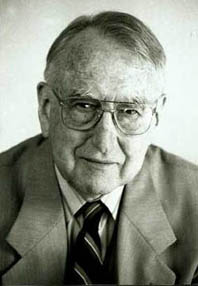
- Gender "theorist" who claimed
that gender identity is socially constructed.
- Purveyed his views by personal dominance
of his field and by falsification and suppression of research
data contrary to his views.
|
|
- Milton
Diamond, Ph.D.
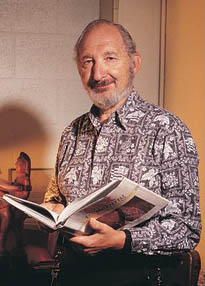
- Professor of anatomy and reproductive
biology who shattered Money's long-held theory that gender identity
is socially constructed.
- His work instead strongly suggests
that gender identity is biologically innate.
|
-
-
- Professor Diamond has since won important
awards for his work. Director of the Pacific
Center for Sex and Society at the University of Hawaii, he
has written widely on issues of gender identity and intersex
surgical interventions. I highly recommend his papers to you
(see for example Sex
and Gender are Different: Sexual Identity and Gender Identity
are Different and An
Emerging Ethical and Medical Dilemma: Should Physicians Perform
Sex Assignment on Infants with Ambiguous Genitalia? ).
-
- The refutation of John Money's theories is finally leading
to a paradigm shift not just in the scientific community, but
also in the medical community - although progress there will
be slower, given the lingering influence of Money's views among
medical "elders". It is also leading to legal assaults
on the continuation of infant genital surgery by "traditional
surgeons". See in particular the recent
article in the Yale Law Review which outlines the emerging
understandings of the medico-legal issues in this area.
-
-
-
-
- The theory that prenatally established brain and CNS
structures determine innate gender feelings and gender identity:
-
- Well now, if it isn't the genes that determine gender identity
(cAIS girls disprove that), and if it isn't the genitals and
upbringing that determine it (cloacal exstrophy boys disprove
that), then what the heck does determine a person's gender identity?
-
- Scientific evidence has been growing that somehow certain
brain-structures
in the hypothalamus (the BSTc region) determine each person's
core gender feelings and innate gender identity. These structures
are "hard-wired" prenatally in the lower brain centers
and central nervous system (CNS) during the early stages of pregnancy,
during a hormonally-modulated imprinting process in the central
nervous system (CNS).
-
- It appears that if those brain and CNS structures are masculinized
in early pregnancy by hormones in the fetus, then the child will
have male percepts and a male gender identity, independent of
whether the genes or genitalia are male. If those structures
are not masculinized in early pregnancy, the child will have
a female percepts and a female gender identity, again independent
of the genes or genitalia. As in the case of intersex infants
having ambiguous genitalia, there are undoubtedly many degrees
of cross-gendering of brain and CNS structures, so that while
some infants are completely cross-gendered others are only partially
cross-gendered.
-
- More recent research indicates that the brain begins to
differentiate in embryonic males and females even earlier, possibly before
embryonic sex hormones come into play, and under mechanisms still not yet
understood - with gender identity then becoming a complex effect of the
interaction between earlier brain differentiation and later embryonic
hormones. For more on this emerging research, see:
"Brain development: The most important sexual organ", in
Nature
magazine, January 29, 2004 (Nature 427, 390 - 392)
- That is why it is possible for some children to have gender
identities inconsistent with their genes. In cAIS cases, for
example, those girls’ brain structures are likely insensitive
to the masculinization effects of fetal testosterone, as were
their genitals. Therefore, they develop the brain structures
and gender identity of females, even though they are XY genetically.
-
- That is also why it is possible for some children to have
gender identities inconsistent with their genitalia and upbringing.
In the case of the boys with cloacal exstrophy ("micropenises"),
their brain-structures and CNS presumably did masculinize under
the influence of fetal testosterone, leading to later male gender
identities even though they had been surgically "turned
into girls" as infants and raised as girls.
-
- Those recent cloacal exstrophy
observations are already having a profound impact in the
medical research community. They are to the science of gender
much like the Galileo's observations of the moons of Jupiter.
-
- These are dramatic, unprecedented, undeniable observations
that shift the previous paradigm of thought, and do so in an
area of science that had been subject to much misinformation
and taboo. In Galileo's case, the shift was from an 'earth-centered
universe' to a 'sun-centered universe'. In the cases here, the
shift is away from a 'genitals + upbringing' theory of gender
identity to a 'CNS neurobiological developmental' theory of gender
identity.
-
- The implications of this paradigm shift are far reaching,
especially for those who suffer from cross-gender identities.
Instead of those gender feelings being considered to be "psychological",
they can now be understood as being "neurological"
in nature.
-
- Listen carefully to the conclusions of William Reiner, M.D.,
a pediatric clinician and researcher at The Johns Hopkins Hospital,
based on his work with intersex children (Reiner is now an
investigator in the Cloacal Exstrophy follow-up study, which
now confirms these conclusions):
-
-
-
|
"In the end it is only the children themselves
who can and must identify who and what they are. It is for us
as clinicians and researchers to listen and to learn. Clinical
decisions must ultimately be based not on anatomical predictions,
nor on the 'correctness' of sexual function, for this is neither
a question of morality nor of social consequence, but on that
path most appropriate to the likeliest psychosexual developmental
pattern of the child. In other words, the organ that appears
to be critical to psychosexual development and adaptation is
not the external genitalia, but the brain."
William Reiner, M.D., To Be Male or Female--That is the
Question, 151 Arch Pediatr. Adolesc. Med. 225 (1997)]. |
-
-
- It is amazing that psychiatrists completely missed all of
this in the past, and so long assumed that gender identity was
neutral at birth and later established by social interactions.
Mis-gendered people themselves have long reported their problem
not as one of THOUGHTS, but of cross-gendered percepts and BODY
FEELINGS - as a little child the gendered feelings of how your
body wants to move, how you respond to being touched, how aggressive
or cuddly you are, how you interact with other little children.
Then, after puberty, one's feelings upon being sexually aroused,
and whether those deep urges are male (mounting urges) or female
(urges of being manipulated and penetrated).
-
- One doesn't "think up" these CNS-produced male/female
gender and sexual feelings, one simply perceives them! The basic
perceptual mechanisms involved are hard-wired, and cannot be
changed by psychiatric means any more than one could permanently
change one's sense of feeling hot into that of feeling cold and
vice-versa.
-
- Whatever in-utero process produces it, a person's gender
feelings and gender identity are at the very core of their being.
Gender identity is fixed, immutable and irreversible by any known
medical or psychological means. We also now know that there is
only one method for determining your gender identity. We have
to ask YOU! Your gender is a percept: You are the only one who
knows for sure what it is, and no one else can tell you what
it is.
-
-
-
-
- TRANSGENDERISM:
-
-
- Now that we know some basics about gender and gender identity
and have some insights into the difficulties faced by intersex
people, we're prepared to learn about and understand transgenderism
and transsexualism.
-
- In this webpage we focus on male to female [MtF] conditions,
since those are within Lynn's direct experience. However, there
is a completely symmetrical set of female to male [FtM] gender
conditions that are almost as common as MtF conditions. For more
information about FtM transgenderism and transsexualism, see
the websites of FtM International
and The American Boyz. The
article "Girls
will be Boys", by T. Eve Greenaway discusses the sudden
emergence of FtM trangenderism out of the shadows and into the
open in many U.S. colleges and universities. For in-depth background
on FtM transgenderism and transsexualism, see the recent book
by Jason Cronwell,
Transmen
& FtMs, and also Jamison Green's book
"Becoming
a Visible Man". See also Lynn's
new webpage listing weblinks
and photos of
Successful
TransMen (es).
-
-
- Introduction:
-
- Hidden away and seldom talked about is the fact that some
apparently normal boys aren't boys at all, but should have been
girls. Although they have normal XY genes, normal male genitalia,
and are raised as boys, they nevertheless have the gender feelings,
body feelings and gender identity of girls. Similarly, some girls
aren't girls at all, but should have been boys. It doesn't happen
very often, but it does happen. And it's always been that way.
-
- Perhaps once in every 200 to 400 births something must go
amiss in the early stages of pregnancy so that sex hormones do
not have the usual action on the integration of the fetus's brain.
In these cases, children are born having a brain-sex (neurological
sex) and innate gender identity opposite to that indicated both
by their genes and their genitalia. Since these infants look
normal, they will be raised in the wrong gender for their brain-sex
(neurological sex). Being raised in the wrong gender causes them
profound gender dysphoria and mental anguish as they grow up.
These are the "transsexuals" (TS), the most intensely
affected of the "transgendered" (TG).
-
- In many more cases, perhaps as many as one out of every 50
children, it appears that the "transgendering effect"
is less pronounced but still present to some degree - and this
occurs in both boys and girls. We can estimate these numbers
from the numbers of gender-variant people who have always coalesced
in and around the gay community. Although a small fraction of
that community, they are perhaps as much 1% to 2% of the overall
population. This group of children presents a wide range of variations
in cross-gender feelings (just as the group of intersex children
present a wide range of genital configurations). Many of these
transgender children will have major adjustment problems if
forced into too strict a gender role.
-
- Women notice these cases, especially the very feminine little
boys who really should have been girls. They'll often even say
among themselves "he should have been a girl". These
common-sense reactions to feminine boys are seldom discussed
outside the closed company of women. Fathers especially will
make every effort to "straighten out" such boys. The
feminine boy is mistakenly thought of as "pre-homosexual".
Every effort is then made to "save the boy from that fate".
On the other hand, the girl who feels like a boy can often become
a "tomboy" and not get criticized for that - in fact
she may even gain approval for being outgoing and aggressive
and tomboyish in our male-dominated society. However, she may
still feel the same degree of gender angst about her assigned
gender role as does the MtF transgender boy.
-
- There is no social script for such a boy to tell someone
"I feel like I'm a girl", and to get active assistance
with their gender problem. Instead, transgender youngsters
often pick up the idea from parents and school-mates that they
are "going to be gay men". Some may later even try
to "become gay" and be accepted in the gay male community,
when in fact that very seldom works. Gay men seek men as partners,
not people whose gender identity is female. The last thing in
the world that an MtF youngster could ever become is a gay male
who is into his masculinity and his male parts even more than
the average guy!
-
- Many other transgender youngsters will secretly find ways
to cross-dress in girls' and women's clothes as a way of exploring
and enjoying their feminine gender feelings, often starting to
do this well before puberty. The denial of opportunities for
openly expressing their gender longings and the need to maintain
complete secrecy about their crossdressing are often the source
of tremendous angst, anxiety and depression among these kids.
-
- A few MtF transgender and transsexual teenagers will try
to appear openly as pretty girls, and may attract straight boys
as love partners (i.e., boys who will love them as girls). Other MtF teens will seek the company of girls, and will become attracted
to them and love them as if they themselves were lesbian. In
such cases, if their girl friends are accepting of them, they
can be wonderful and attentive lovers and partners. However,
many transgender youngsters will become so ashamed and humiliated
by their female tendencies that they will hide their "terrible
secret longings" from everyone, sometimes even from themselves,
for a long, long time.
-
- For those who are strongly transgender or transsexual,
living without having a properly assigned gender produces a nightmarish
separation from the dance of life. Whether it's dating, finding
love, courting, marrying, raising children, and generally doing
all the little everyday things that continually celebrate one's
own gender, the transgendered are often left stranded on the
sidelines, to watch as spectators. Or worse yet, while feeling
ugly and ludicrous in their male social appearance, they are
forced to "act out" empty of all feeling a role that
is alien to their inner female nature.
-
- The overall name for the intense form of these cross-gender
feelings is "gender dysphoria". (This condition is often called "gender identity
disorder" (GID). However, we refrain from using the word "disorder", because we
consider this condition to be a natural variation in human gendering. Instead we use
the phrase "gender dysphoria", referring to the angst felt at being forced to live in
the wrong gender). For a more formal description of "GID" and background
on exploratory research in this areas, see the following links
at the Gender Identity Research
and Education Society (GIRES) website:
-
-
-
|
GIRES
Main Page
Gender
Dysphoria [2004]
Definition
and Synopsis of the Etiology of Adult Gender Identity Disorder
and Transsexualism.
"In conclusion, transsexualism is strongly
associated with the neurodevelopment of the brain...The condition
has not been found to be overcome by contrary socialisation, nor by
psychological or psychiatric treatments . . . Individuals may
benefit from an approach that includes a programme of hormones and
corrective surgery to achieve realignment of the phenotype with the
gender identity, accompanied by well-integrated psychosocial
interventions to support the individual and to assist in the
adaptation to the appropriate social role . . . Treatments
may vary, and should be commensurate with each individual's
particular needs and circumstances."
- Quote from the GIRES synopsis of current
research on the etiology of GID; this document was signed by the
world's leading researchers in the field. |
-
-
-
- Counseling and medical treatment of transgender and
transsexual women:
-
- Gender counseling services and support groups now exist in
many major cities to help the transgendered diagnose their conditions
and become aware of options for social gender-change and for
medical help. The web now offers a large number of
transgender
and transsexual support sites that provide a wide range of
practical information regarding counseling and transitions. Many
of those sites keep up-to-date lists of service providers for
TG/TS people (counselors, electrologists, endocrinologists, surgeons).
Some of these websites (such as the TG
Forum) also list clubs, support groups and important national-level
events where TG people can congregate for mutual support.
-
- In many cases, relaxed gender constraints and flexibility
of dress, mannerisms and presentation can ease the discomfort
of the transgendered and greatly improve their opportunities
for honest self-expression and for a sense of well-being and
happiness. In many cases where the individual finds some degree
of inner peace and self-acceptance that way, they can go on to
find love and enjoy life fully without further gender modification
efforts.
-
- However, people having very strong transgender feelings may
consider making physical changes by taking sex hormones and social
changes by permanent cross-dressing, and thus undergoing a "transgender
transition", usually with the advice and guidance of
a practical-minded gender counselor. Many people now pass through
transgender transition each year, and then live out their lives
in the social gender they feel most comfortable in, while remaining
somewhere in the middle of the physical gender spectrum (i.e.,
without undergoing sex reassignment surgery to modify their original
genitalia).
-
- The gender trajectories of TG women vary considerably from
person to person, depending upon many factors including the intensity
of their condition and the initial timing and method of openly
expressing their condition.
-
- For example, in past decades it was very common for intense
young TG girls to migrate towards the gay "drag scene"
(see below), where they had opportunities to openly cross-dress
and perform in public, and to experience being attractive to
men and in gaining the favors of men (albeit gay men, who thought
of them as boys). It was no secret that there was always a minority of the gay
"drag queens" who were not gay boys at all, but who were actually
transgender (or even transsexual)
girls.
-
- With the recent proliferation of heterosexual male crossdressing
clubs and groups (see below), and the many opportunities these
days for safe crossdressing in such environments, it has nowadays
become even more common for young TG people to initially think
of themselves as being male crossdressers and to be attracted
to the crossdressing scene. Only over time do they realize that
they are not solely interested in crossdressing for the autosexual
sensual buzz. Sensing that they are not really like the majority
of male crossdressers (who usually have wives and girlfriends
at home), they begin to confront their underlying gender dysphoria.
Once this awareness of difference develops, the TG person usually
migrates away from the CD scene, and on into interactions with
gender counselors and TG support groups.
-
- National-level gender conferences also now enable people
who are just beginning to explore their gender issues to anonymously
attend one big event and get an introduction to the entire range
of transition options. Conferences such as Southern
Comfort and the Colorado
Gold Rush, although mainly being big gatherings for heterosexual
crossdressers, also include excellent clinics and workshops to
help people get started on gender transition. Anyone questioning
their gender identity can attend one of those conferences (in
boy or girl mode), meet and talk with people in all stages of
transition, and quickly gain a lot of information into the how-to's,
challenges and possibilities of transition.
-
- The web has had a profound effect on the TG world by stimulating
very rapid propagation of knowledge about transition, and by
helping people network and share information. With the emergence
of the web and the widespread availability of electronic information
of transgenderism and transsexualism, many TG people now bypass
the gay drag clubs and heterosexual male crossdressing scenes
for their first gender explorations. Instead they go directly
to the big gender conferences, to gender counselors and to TG
support groups for assistance, and quietly and rather anonymously
explore their options for gender modification and possible transgender
transition. Intensely transsexual (TS) girls also sometimes undertake
TG transition and live as TG women for extended periods of time
before undergoing sex reassignment surgery (see Part
II: Transsexualism).
-
- Transgender transition doesn't require anyone's or any authority's
"permission", although it is usually done with the
coaching of a gender counselor. The MtF TG transitioner works
hard to feminize their appearance and manners as much as possible
by taking female hormones, removing facial hair via electrolysis,
and making adjustments to the voice and many other behaviors.
Some TG transitioners will also undergo cosmetic surgery to improve
facial features and/or augment their breasts. Once these changes
have proceeded far enough, the person then transitions socially
by permanently dressing in their new gender, legally changing
their name, and getting all their identification shifted into
their new name and gender (which is now relatively easy to do
in many states in the US). There are still many difficulties
on this path, because society does not yet readily accommodate
someone who is physically "in-between" the two standard
genders. However, in some cases transgendered women who have
transitioned have become very successful in life, have gone on
to fine careers and have found wonderful love-partners too.
-
- Some examples of TG women and their stories are found in
the following photos and weblinks. These photos show the possibilities
for successful transgender transitions without SRS (although
some of these women have or will go on to complete transsexual
transitions, by also undergoing SRS):
-
-
-
-
Calpernia Addams in 2000:
- A beautiful transgender woman
- who has been feminized by taking
estrogen
-
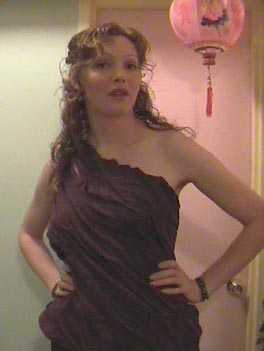
- For more about Calpernia,
see
Part Ia.
- Since this photo was
taken Calpernia
has undergone SRS.
- See
Calpernia's
new webpage and her new book
Mark
947.
-
Her story is also
told in the movie
Soldier's Girl.
-
-
-
Chrysis, a stunning
TG woman who was a cabaret
-
performer in New York City in
the 70's and 80's.
-
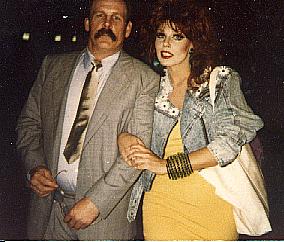
- Here we see Chrysis with Nick
Nolte, on the set
- of the movie
Q&A
(in which she appeared)
-
-
-
-
-
-
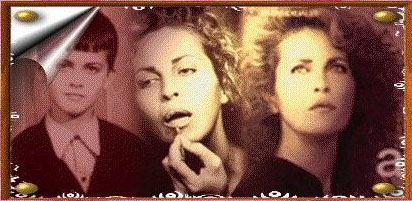
- Carla Antonelli,
a beautiful trans actress from Spain.
-
-
-
-
-
- Miriam, a stunning transgender
woman from the UK.
- Miriam is very happy as she is, and is not planning to have SRS.
-

- Miriam was the
subject
of a controversy recently
- regarding her appearance in a "reality
TV show" in the UK.
-
-
-
- In the more intense cases of transsexualism, the TS girls'
initial trajectories may appear similar to those for TG people.
However, the ultimate resolution of their condition requires
more than just a hormonal and social-gender change. The only
way for them to resolve their condition is to also completely
change the physical sex of the body to match their innate gender
feelings. This means undergoing a "transsexual transition",
which in the case of a male to female (MtF) transsexual involves
completely changing the body from that of a boy to that of a
woman. This is done by taking female sex hormones AND by undergoing
sex reassignment surgery (SRS) to
reconstruct the genitalia from male to female. Transsexual transition
in the U.S. is conducted under formal
medical protocols that require counseling, hormone therapy,
and a "real life experience" of at least a year of
living and working in the new gender before the patient is recommended
for SRS (see Part II. Transsexualism)
- .
-
-
-
-
Harisu,
a pretty young Korean transsexual girl
who
transitioned in her teens with the help of her mother and
had MtF sex reassignment surgery at age 19. Harisu thus underwent
'transsexual transition' and is now a postop TS woman.
|
 |
|
 |
-
-
-
-
-
-
- There are at least 32,000 to 40,000 post-operative transsexual
women in the U. S. (see TS
Prevalence information, in Part II ). About 1500-2000 U.
S. residents now undergo male to female sex reassignment surgery
each year, so the overall number is expanding fairly rapidly.
As we'll see, many of these women have gone on to very successful
lives after TS transition.
-
- The numbers of transgender women and the numbers undergoing
transgender transition are many times those numbers for transsexuals.
Therefore, it is likely that many hundreds of thousands and perhaps
several millions of people in the U.S. are transgendered.
-
-
-
- Other conditions that overlap with or are
often conflated with transgenderism
and transsexualism:
- (i) being Gay (ii) Drag Queens, (iii)
"Female Impersonators", (iv)
Crossdressers
("Transvestites"), (v) Travestis ("She-males"), (vi)
Fetishists and
(vii)
Others
-
- Transgenderism and transsexualism are often mixed up with other
common conditions involving cross-gender behaviors
or appearances. We can learn more about transgenderism and transsexualism
by contrasting them with these other conditions, and by visualizing
the sometimes blurred boundaries that exist among
these conditions.
-
- As we discuss these conditions, remember that "labeling"
is very imprecise in this field. Different people label things
differently. Some people consider ALL situations involving cross-dressing
as being under the "overall transgender umbrella".
However, there are fundamental differences between
those people who have cross-gender identities
significant enough to lead them to transition (TG and TS people),
as compared to those transvestites or gay male drag queens who
are male-gendered. Unless those differences are well understood,
lumping these situations together under one label can cause major
confusion.
-
- These confusions can also affect young TG/TS kids themselves
as they struggle with their gender issues early in life. As we'll
see, many TG/TS kids initially think that they must "be
gay", or that they are "drag queens" or "crossdressers",
as they try to pattern on something that seems to speak to their
issues. As a result, many young TG/TS people migrate through
the gay club scene and the crossdressers' clubs, on the route
to working out their gender issues.
Also note that the emotions and feelings of
gender variance are expressed in different ways in different cultures,
depending on available social roles in which transgender people can exist in
each culture. Different words may be used to describe of gender-variant people in
a particular culture. These
“types” vary widely from culture to culture, and evolve over time within each
culture. See Lynn's page regarding
the situations of TG/TS
people in different countries and also
the
TransgenderAsia
website, for examples of widely varying transgender typing in many different cultures.
See also the following page concerning the difficulties in
cross-cultural communications and language translations regarding gender variance. As
one example, that page discusses how the word
“travesti” in Romance languages (such as Spanish, Portuguese, Italian, etc.) is
very often confused with the word “transvestite” in English (a word that has a
very different meaning). As we will learn, gender-variation typing and labeling are
highly culture-dependent and language-dependent, and are very inexact practices.
-
-
-
- (i) confusion of TG'ism and TS'ism with being Gay:
-
- Over 5% of all men and women are gay, and prefer to mate
with love-partners of the same sex and/or gender. This innate feeling of
same-sex attraction in many people is a part of human nature.
It has always been so, in spite of ongoing efforts by various
religions and societies to stamp it out. It seems that love always
finds a way to thrive, in spite of all obstacles.
-
- Because being gay is so common, transgenderism and transsexualism
are most often confused with simply being gay, and in fact confused
with being "really, really gay". The first thing that
pops into the people's heads when they hear that someone is transsexual
is, "wow, I didn't know 'he' was gay".
-
- It's easy to see how people might jump to this conclusion.
Seeing an MtF TS woman with a straight man as her partner, they
simply think that she is (or was) a "gay man". They
jump to the conclusion that "he" changed sex simply
in order to attract men as partners. However, this is a totally
mistaken idea rooted in ignorance about gender identity. And
as we'll see, this idea totally mixes up and conflates two totally
different kinds of people: transsexual women and gay men.
-
- How did the confusions get started? One possibility is that years ago many
gay people got into "role-playing". For decades and decades there have been
gay men who act "effeminate", and who emulate the "woman's" role in a
relationship, even though they are strongly male-gendered and don't feel
like women at all.
-
- Gays and lesbians
have also often allowed themselves more freedom than heterosexuals to break the
rules of gender behavior as well—especially within closed or “friendly”
social environments. Even so, the
majority of gay and lesbian people have gender expressions difficult or
impossible to distinguish from that of heterosexuals.
-
-
However,
effeminate gay men as a minority of the gay male community
have been far more publicly visible than TG/TS women, because the gay male
community is so large to begin with. After all, over 5% of all men and women
are gay, and prefer to mate with love-partners of the same
sex and/or gender. Meantime, TG/TS women have
mostly had to live in stealth in the past, staying as "invisible" as
possible just to survive, and they were much smaller in number than gay men
to begin with. All this led many straight folks to confuse "role-players"
and feminine-acting gays as being gay men who
"really wanted to be women."
-
-
Such gay role-playing is now mostly a thing of the
past, and most gay people nowadays appear to be normally gendered. They
"pass" as just plain regular folks in the everyday world. Sure, some gay
people still display cross-gender appearances and mannerisms in order to
signal their partner preferences, but these people are usually
normatively-gendered as men and women. Their "role-playing" displays are
about where they fit into the gay world, and aren't usually a gender issue.
-
- Now, here's the deal: A gay man has a male gender identity.
He is attracted to males who also have a male gender identity,
and who are attracted to him because he is a male. The last thing
on earth that a gay man would want to do is change sex and become
a woman. To do so would be a catastrophically self-destructive
act, because of his male gender identity and his love of masculinity
both in himself and in his partners.
-
- In contrast, an MtF TG or TS woman has a female gender identity. She may
be either straight or gay after she transitions. She is either
attracted to males who have a male gender identity or to females
who have a female gender identity, and who are attracted to her
because she is a female. She is desperate to change her body
so that she can fully feel like and be perceived to be a woman
- both by herself and her lovers. If it turns out that she is
"gay" after her transition, it is because she is a
lesbian in her new role, not because she is a "gay man".
-
-
-
- (ii) Drag Queens:
-
- Some gay men occasionally dress in "drag" for fun
and as a kind of caricature of women (DRAG = "DRessed As
a Girl"). They'll sometimes they "go in drag"
to bars and clubs, and sometimes on special occasions and for
various fun events. Gay men who are particularly skillful female
impersonators perform in drag in various gay nightclubs (such
as the club "Oz"
in New Orleans). Some of these gay men, such as
Ru
Paul, have great skills as "illusionists" and have
become famous mainstream drag performers.
-
- RuPaul
- a famous drag performer
-

-
-
- The origins of this fairly common practice go way back in
gay culture. These men are called "drag-queens" (DQ)
and are usually completely male-gendered gay men. Many of them
started in drag as gay teenagers when they discovered it was
a way to attract lots of attention from men in gay clubs. They
make no permanent body modifications by hormones and rely on
great performance skills and skill with clothing, prosthetic
props and makeup to create their female bodily images. As gay
men they tremendously value their masculine genitals. They are
totally turned off by the concept of "sex changes",
and would never consider such a thing themselves, any more that
any other gay man would.
-
- There is a rather large gay-male subculture of drag performers
and drag contests all across the U.S., and there is always some
small fraction of young gay men who are attracted to the "lifestyle"
as it is sometimes called. For many of these young men, even
those who aren't particularly attractive as boys, performing
in drag in a gay club is a sure-fire way to attract gay male
lovers and attention, at least while they are still young. However,
outside the clubs these gay boys are almost always boys again,
and since they do not take hormones or make major body-feminization
modifications very few could pass as women in the light of day.
-
- Many transgender and transsexual youths, on learning that
they could dress and perform as "girls" in local gay
clubs, feel a strong tug to join that scene and initially may
even self-identify as drag queens. This has always been a common
path for TG/TS kids who are beginning to explore their gender
issues. After going to these clubs for a while, these TG/TS girls
usually realize that they aren't gay male "queens"
after all. Many tire of the attention of gay men who want them
precisely because they "are boys", instead of wanting
them to love them as women. They gradually learn about other
girls who've taken hormones and had electrolysis and breast implants,
and who can "pass" as women outside the clubs. Better
yet, they hear that some of those girls are finding straight
boyfriends who love them as girls. As they learn about the possibilities
of "going full-time" by undertaking a TG or TS transition,
they may begin to plan their own transition too - and work to
move on beyond the part-time gay drag scene and out into heterosexual
society as a transitioned woman.
-
- Thus there has long been a mixture of DQ, TG, and TS girls
in the gay drag scene, because so many TG and TS girls continually
migrate through that scene and on out into the world beyond it.
Although the majority of girls performing at the gay clubs are
gay queens, there are always a few TS's in among them. This isn't
a bad way for some TS girls to get started, because drag clubs
are often a fun-loving, uninhibited, non-judgmental environments
where they can feel very liberated and able to explore their
gender issues. For an inside look into "the lifestyle"
by a transsexual girl who passed through the gay club scene,
see Calpernia Addams' wonderful book
Mark
947.
-
- For more insight into the world of drag queens, drag performances
and drag contests, you can explore the links to drag clubs from
many gay male community websites. Of special interest
are the major beauty and performance contests, such as the famous
Miss
Continental pageant
(more), which provide opportunities for the
expression of feminine beauty by large numbers of DQ's and TG girls.
QUEENMOTHER.TV
, the online outpost of New York City's thriving drag performance
community, is another good window into the drag community.
-
- Drag queens (DQ's) themselves are often confused by the public
as being "transsexuals", and vice-versa. The extravagant
caricatures of femininity presented by many drag queens tends
to propagate a misleading image of transgender people as being
male-gendered people who like to caricature women in flamboyant
ways. Then too, people familiar only with MtF transsexualism
may mistakenly assume that a drag queen has a female gender identity,
which he
generally does not.
-
- Some gender theorists consider drag queens to fall under
the "transgender umbrella", a term that lumps all gender-variant
people together. Lynn finds this over-inclusive terminology very
confusing, since the majority of drag queens unquestionably self-identify
as male-gendered, do their crossdressing just for fun, and seldom
self-identify as "transgender" since they do not
have any issues with gender identity. The best way to learn whether
a drag queen considers themself to be "transgender"
is to ask them, rather than automatically label them that way
just because they do drag.
(iii) Female impersonators (FI's), and the historical
role of FI clubs in disseminating knowledge about gender transition:
Back in the 1950's and 60's, many people's only encounters with drag queens and trans girls was by attending gay nightclubs
that featured "female impersonators". The girls were seldom seen
outside of such clubs, because it was against the law in most places for "males" to dress as girls in
public back then. As a result, "female impersonator" (FI) became a common
public perception of (and label for) drag queens and TG/TS girls back then.
In those very inhibited
and incredibly homophobic years, the idea of going to a
nightclub where young "men" performed as beautiful young
women struck a deep chord in many socially conformist heterosexuals. Perhaps
a sampling
of what appeared to them to be "forbidden and decadent" ways of life gave them a sexual buzz or made them
feel very sophisticated.
Whatever the reason, some of the female impersonation clubs in larger cities began to attract lots of
straight tourists.
Certain clubs, such as
Le Carrousel in Paris
and
Finocchio's in San Francisco, became world famous attractions by featuring the most
beautiful and talented of DQ's and TG/TS performers. Those clubs then became magnets for many young trans girls,
because as
performers they had "an excuse" to be seen as girls by the public at least some of the time.
Even more importantly, the social network of trans girls working in such clubs
provided newcomers with access to many then-emerging secrets and methods
(hormones, electrolysis, silicone, etc.) for feminizing their bodies.
It was while
working at Le Carrousel in the mid-1950's that several young, intensely
transsexual girls began taking the estrogen just then becoming
available in pharmacies. As a result, they developed beautifully shapely bodies
and delicately soft features that stunned audiences at the club. One
performer, named
Coccinelle, went to
Dr. Georges Burou of Casablanca, Morocco in 1958,
and became one of the first patients to undergo the modern
form of sex reassignment surgery (which Burou had just invented). Two
years later another Le Carrousel showgirl, named
Bambi,
also went to Dr. Burou for SRS.
Coccinelle and
Bambi continued to perform at Le Carrousel
following their surgeries, where they were seen by large audiences that included many
famous and wealthy people. As a result, the news of their successful "sex changes"
spread like wildfire, adding to their fame and to the mystique of the club.
The TS transitions
of Coccinelle and Bambi triggered a sudden and widespread dissemination of knowledge out
into the transgender world about how to undertake and carry out a gender
transition. Up until then, although many people had heard of
Christine Jorgensen's
"sex change", there was little detailed practical
information about how to undertake such a transition on one's own. The girls at
Le Carrousel changed all that, by talking with others about what they
had done and how they had done it. Their performances at the club also
spread the beguiling and culturally revolutionary image of
"transsexuals" as being very beautiful, talented and sexually desirable women
(which unfortunately later led to a vicious backlash against trans women by feminist
thought-leaders).
Coccinelle and
Bambi (Marie-Pier Ysser) went on to live wonderful lives over the longer term, and
you'll now find links to their stories in Lynn's
TS Successes pages (at the
end of photo gallery 4).
Historical information about Le Carrousel can be also found
at this link
The wonderful website of
David de Alba provides a memorable look back into the female impersonation
clubs and the FI culture of the past. His site includes a page about
Finocchio's,
and additional
background on that club can be found in this
planetout.com article. Vicki Rene's
website also spotlights many
of the beautiful nightclub performers of yesterday and today, in her
fabulous "Showgirls pages
(more)".
The tradition
of "female impersonation" continues on even today at famous big-city nightclubs
such as The Baton Show Lounge in Chicago,
where you can see performances by talented and beautiful entertainers such as
Mimi Marks (more). While some
of the performers at such clubs are drag queens who live as
men outside of work, others such as Mimi are socially transitioned trans
women.
Mimi Marks - a
famous transgender showgirl
featured at
The Baton Show Lounge in Chicago

Crowned
as "Miss International Queen" in 2005
(photos,
more,
more,
more)
-
- (iv) Crossdressers
(Transvestites):
-
- Many heterosexual men occasionally engage in partial or full
crossdressing* (CD'ing) as a means of feeling sensual and as a fun sexual
turn-on. This has long been called transvestism* (TV'ism),
and perhaps as many as 20% to 30% of ALL males do it sometime during their
lives.
-
- [*See Lynn's page "The
Wide Spectrum of Gender-Variant People and the Words Used to Describe Them"
for a discussion of such terminology, and how the meanings of such words
have shifted over time. For example, the word "transvestism" in
English has gradually fallen out
of use due its social and psychiatric stigmatization in the past, and the
word "crossdressing" has gradually replaced it. Then too, the old
word "transvestite"" in
English is often confused with the term "travesti" in the Romance languages
- which refers to an altogether different form of gender variance (see
below)].
It is important to realize that this is a very, very common practice, and
thus we need to put it clearly in perspective in the overall picture of gender
issues.
Crossdressing is often simply a regular expression of male
sexuality similar to the use of pornography for pleasurable visual
arousal and auto-sexual release, and in these cases is not a
gender issue at all. Sexually active males who are turned on
visually by females may get very excited by seeing part of themselves
as female by wearing a bit of women's clothing. Some of these
men then gradually get into fully crossdressing as a means of
experiencing more sensuality and turn-ons than they otherwise
might. However, it is important to note that
crossdressers and transvestites generally do NOT modify their bodies through
surgical or hormonal means.
- As transvestic males mature, perhaps 1/10th of them (2% to
3% of all males) progress to occasional full crossdressing, and do this either
in private or in clubs for crossdressers.
There are millions and millions of regular "straight"
guys who are transvestic, and this form of full-crossdressing
is actually very common. Past and present public figures who
are widely known as transvestites include J. Edgar Hoover, Jeff
Chandler, Milton Berle, Flip Wilson, Dennis Rodman, Marv Albert
and a huge list of other rather masculine and often very sexy
men.
-
- Some of these men may appear quite attractive dressed up
as "women" in photographs or in the dim light of club
settings, but their mannerisms and manly-type assertiveness usually
reveals that they don't feel like or think of themselves as women,
nor do they really try very hard to act like women. These folks
simply do this for sensual fun. By dressing his body in soft,
seductive female clothing, the crossdresser can experience a
wonderful male sensuality upon seeing his own apparently feminized
body. Because of this focus on self-arousal, transvestites often
dress in a "glamorous" manner that is rather stereotypically
female and even provocatively sexy - dressing in fancy gowns,
stockings, high-heels, etc., in ways that most women do only
on rather special occasions.
-
- Although many transvestites crossdress primarily to enhance
their male sensual experiences, There are many other crossdressers
who do have transgender feelings to one degree or another. In
these cases, transgender feelings and the need to ease gender
angst often loom as primary motivations for crossdressing.
These persons may refer to themselves either as crossdressers or as "transgender".
-
- Some crossdressers, especially among those who have fairly strong
transgender feelings, long to cross-dress more freely in public
and also part-time at work. A few may even undergo a transgender
social transition in order to crossdress "24/7" (i.e.,
all the time) and then self-identify as being transgender.
-
- Years ago, it was difficult for men to easily acquire women's
clothing, because of fears of being thought of or "outed"
as a crossdresser. Fortunately, it's much easier these days.
In addition to many catalog and web-based suppliers of women's
clothing (including many comprehensive catalogs such as the
J.C. Penney catalog), there
is now a huge infrastructure of stores, services and catalog-order
firms supplying clothing and fetish wear specifically for crossdressers.
One of the oldest and best-known suppliers of such fetish wear
is Frederick's of Hollywood.
In recent years, ordering via the web has become an ever easy
way for crossdressers to obtain clothing and supplies (for examples,
see: TGNOW Shopping Directory,
TG Forum Shopping
Mall, Glamour
Boutique, Fantasy
Girl ). These TV/CD suppliers provide some important advantages
over traditional women's clothing sources such as J.C.Penney,
because they stock large sizes of everything, including shoes,
and their clothing also covers a wider and more sensually exotic
range of styles.
-
- Furthermore, many
crossdressers' clubs and support groups
have been formed to enable transvestites and
crossdressers to meet and enjoy crossdressing
in safe, fun social environments. The oldest and perhaps most
influential national club for male crossdressers is named
Tri-Ess.
Founded decades ago by Virginia Prince, a
self-identified transvestite who was
publicly out back then, Tri-Ess now has chapters all over the
U.S.
Unfortunately, Tri-Ess chapters (and many other old-time CD clubs)
only accept avowed "normal heterosexual males" as members,
and they specifically exclude "homosexuals" from membership.
Transgender and transsexual women who are just beginning to crossdress
and come out , but who are bisexual or attracted to men, are
NOT allowed to become members because they are considered
to be "homosexuals" by Tri-Ess.
-
- This exclusion should not be surprising. Tri-Ess's founder,
Virginia Prince, was a frequent speaker about "sex and gender"
at the early medical conferences on transsexualism in the 1960's
and 70's. Prince portrayed transvestism as a "love of the
feminine" by normal heterosexual males,
to differentiate them not only from “ordinary” homosexuals but also from
transsexuals, who were thought by most behaviorist psychologists
of the time to be an extreme form of homosexual. (This was
yet another byproduct of John Money's faulty theory of gender
as a conditioned social construct, leading psychologists and
psychiatrists to envision transsexual women as intensely gay
men who sought SRS so they could more easily have sex with men.
See the following link for more
modern
views about the causes of transsexualism).
-
- Prince's talks implicitly exploited transsexualism as a foil
to elevate the image of transvestism by characterizing it as having higher,
purer, more intellectual motivations. Since those talks echoed
and reinforced the old paradigm that transsexualism was "about
sex" (and in particular "gay sex"), Prince's views
were taken quite seriously by many male psychiatrists of the
time.
-
- As a side-effect of that activity, Prince embedded an intense
homophobia and transphobia into Tri-Ess culture where those phobias
still linger today. One senses that the internal feelings of
shame and embarrassment felt by many Tri-Ess crossdressers have
long been eased by proclaiming "I may wear dresses, but
at least I'm not a faggot or a sex change". In addition,
the Tri-Ess exclusion of TG/TS members may also be designed to
calm fears of members' wives and girlfriends that their men may
be tempted into "homosexuality" or even into transitioning
if any TG/TS women managed to get into Tri-Ess.
-
- Exclusion from many CD clubs presents a problem for young
TG and TS girls who try to enter the crossdressing scene early
in their transitions, thinking of that as a way to "try
out their wings" at gender crossing. Some even initially
think that they are just CD's, and only later sense their deeper
gender issues. Occasionally a young TG/TS girl just coming out
to herself may try to join Tri-Ess, thinking that she might find
help there. This can lead to awful rejection, and can damage
a young TG/TS woman's feelings at a most critical time in her
life. Therefore, young folks who think there is any chance they
might have transgender or transsexual feelings are strongly advised
to NOT join Tri-Ess, but to seek other more inclusive CD clubs
that openly welcome TG/TS people. Of course, transvestic men
who want to join a CD club that only includes other "normal
heterosexual men" will feel very much at home in Tri-Ess.
-
- Fortunately, the paradigms of crossdressing are changing
rapidly now, and more fun-loving, openly inclusive CD/TG/TS clubs
are forming and gaining widespread membership. Finally, in the
early years of the 21st century, it seems that crossdressing
is beginning to move beyond the fear, shame, embarrassment and
secrecy of the past and is becoming a warmly-fulfilling pastime
for many people - frequently with the loving support of partners
and spouses.
-
- An example of a much more "TG-oriented" CD club
that welcomes TG and TS women is Crossdressers
International (CDI), in New York City. They are a CD support
group having an apartment in the City where they meet, and where
new sisters can come out. Every Wednesday night, TS or TG or
CD folks can join them and socialize and have a little dinner.
People can dress in the apartment and feel free to express their
femme side, and some go out to dinner or a club in NYC after
the meeting.
-
- There are now also wonderful "makeover services"
offered in many cities now, such as at FemmeFever
on Long Island, NY, where crossdressers can go for very personal,
skillful, knowledgeable and supportive help in developing and
experiencing their "female persona". To get an idea
of the possibilities of makeovers,
see
the amazing "before/after" photo page in the FemmeFever
site, showing some really nice-looking guys and their photos
as pretty gals after their makeovers. In addition to these services,
FemmeFever is also a focal point for a large CD/TG/TS community
in that area, holding many social events that can help newcomers
come out and enjoy themselves.
-
- See the
wonderful
Guy/Gal - Before/After photos
- at the Femme
Fever website:
-

-
-
- Hopefully more and more CD clubs and activities will also
become inclusive and welcome TG/TS women, especially those who
are first coming out and so very vulnerable at that time. Those
clubs could help beginning TG/TS women get off to a better start
on their presentation and manners than they might on their own.
-
- In addition to local TV/CD clubs and various chapters of
national organizations, the CD community is also a major factor
in the staging of several national-level "gender conferences"
each year. These major events attract large numbers of attendees,
and provide the community with wonderful places to safely congregate
and enjoy many social activities staged in wonderful hotels.
Three especially large events are the
Colorado Gold Rush
held late each winter in Denver, Colorado, Chicago's Be-All held each June in Chicago, Illinois, and
Southern
Comfort held early each fall in Atlanta, Georgia. Participation at these
events includes people from all across the gender spectrum, and
the conferences are increasingly billed as TG conferences. However, crossdressers are the largest group among attendees and CD'ing
is a major focus of these events.
-
-
- The Colorado
Gold Rush, Southern Comfort and the Chicago Be-All:
- National-level transgender conferences
and crossdressing events.
-
-
-
- Attending one of these conferences is an excellent way for
someone who newly recognizes that they are TV/CD/TG/TS to come
out to themselves, mix and mingle among many diverse and interesting
people, quickly learn about the overall community, and begin
to find themselves. The conferences provide crossdressers with
a great way to enjoy CD'ing openly yet anonymously within the
large hotel environment for many days. These conferences also
include all sorts of practical seminars and self-help sessions
for TV/CD/TG/TS people on everything from the basics of feminine
grooming and presentation all the way to seminars for TS women
by TS care providers and surgeons. These conferences represent
a more future-oriented, fun-loving, less fearful way of enjoying
being CD and at the same time are helping the broader TV/CD/TG/TS
community get to know one another and better understand one another.
-
- Terminology can once again become a confusing issue when trying to talk
about crossdressing within the larger context of gender conditions. Some "gender theorists" consider crossdressers (CD's)
and transvestites (TV's) to fall under the
so-called "transgender umbrella",
even when they identify as having a male gender identity.
Since there are many,
many more of these male-gendered heterosexual male crossdressers than there are transgendered
people, gender activist organizations usually include
them (and also drag queens) in their definition of the
"transgender umbrella", in order to draw on their larger
numbers for financial support.
Furthermore, although
one’s wardrobe does not determine one’s gender identity, crossdressing
inherently IS a form of transgender behavior - and the people who engage in it do
sometimes wind up the subject of the same hateful, antiquated and discriminatory
attitudes of society and the legal system that afflict other gender variant
groups.
- However, Lynn observes that such terminology can be
very confusing. Crossdressing males who self-gender themselves fully as
males really shouldn't be confused with MtF transgender women who crossdress
primarily to experience and express a female gender identity. Many
transvestic crossdressers fully acknowledge themselves to be men, and many
of them actually resent being mistaken as "gay" or "transsexual", thinking
of those labels as being rather demeaning.
-
- The traditional TV/CD community is witnessing an ever increasing
flow of TG/TS girls through the CD scene. Some of these kids
are questioning and are unsure of whether their ultimate gender
trajectory will be CD or TG or TS. Meantime, everyone involved
is becoming better educated about the differences in the inner
feelings and identities of TG/TS girls from those of the more
widespread heterosexual male crossdressers and
transvestites. Static labeling
just doesn't seem to work anymore in such fluid communities.
-
- Since there is no sharp dividing line between transvestic male crossdressers and those crossdressers who have transgender
feelings and those who do not, it seems best to leave the labeling up to the individuals
themselves. Many crossdressers dislike being labeled transgender,
while others may prefer to be labeled that way, because they
do feel some degree of female gender identification. In those
cases people should honor the transgender identification.
-
- Unfortunately, the overall crossdressing scene is still dominated
by a pervasive cloud of shame, embarrassment and fear because
of the long history of social stigmatization of transvestism.
The vast majority of crossdressers are still extremely fearful
about being outed to their spouses, families, friends and co-workers.
This fear is based in the reality that if discovered or outed, crossdressers can become the targets of harassment, hate crimes
and very intense employment discrimination, as in the recent
"Winn-Dixie"
case.
-
- Worse yet, the mental health establishment still classifies
male "transvestic fetishism" as a "mental illness"
(just as they used to classify homosexuality, until they learned
better). Although this classification, in the American Psychiatric
Association's Diagnostic and Statistical Manual of Mental
Disorders (DSM-IV-TR), 2000, has recently come under attack
from many directions, it nevertheless casts a further pall over
the CD scene, reinforcing the fear and shame so common among
crossdressers.
-
- Sadly, it is likely that any actual "diagnosed mental
illnesses" associated with crossdressing are simply "iatrogenic
artifacts" of the stigmatization by the medical community and society at
large. In other words, the mental problems aren't due to the crossdressing, but are actually
depressions or anxieties CAUSED by psychiatrists' and others'
efforts to "stop transvestic behaviors" even in cases
where crossdressing is clearly beneficial to the person's well
being. For a recent paper on this topic, see
this
link. For an extensive critique of psychiatric stereotypes
of gender diversity, see the Gender
Identity Center of Colorado's webpage on GID reform.
-
- The non-scientific classification of harmless, pleasurable
crossdressing as a mental illness has long been a source of fear
and discrimination against not just crossdressers, but against
all transgendered people. Hopefully, gender activists will be
able to educate and raise people's awareness that the old-time
psychiatric establishment's view about crossdressing just don't
make sense, and that they unfairly stigmatize people who are
just enjoying themselves, exploring their inner gender feelings,
finding some peace, and doing no harm to anyone.
-
- Fortunately times are changing. Many modern crossdressers
and their SO's are breaking out of old-time paradigms of thought,
and simply going on to enjoy who they are and what they do. Although
many still feel the need to completely hide their
crossdressing from their wives or girlfriends, many others are coming
out to their partners. As a result, many wives and girlfriends
are finding that they can fully accept and support a partner's crossdressing, especially if this helps him become a much happier,
more sensual, more passionate and more loving person. For example,
see Alison's
website, which describes Alison's relationship with partner
Sue, and also
Kathy
and Amanda Bower's Home Page, describing Kathy's wonderful
relationship with a partner who is not only understanding but
also accepting and indeed enthusiastic. For more about the trend
towards a new paradigm of family openness and comfort about crossdressing,
see the newly published book by Helen Boyd:
-
-

|
- My Husband Betty
is a book by Helen Boyd, the wife of a crossdresser. She has
writen this book in an attempt to help both wives and crossdressers
see past the 'shame and secrecy' paradigm that currently permeates
the crossdressing community. The general attitude - that crossdressing
is a problem that must be "coped with" in a relationship
- prevents more positive attitudes about crossdressing from flowering.
Additionally, Helen has found that the crossdressers themselves are
beginning to acknowledge their place in the TG spectrum, and
is hoping that the new generation of crossdressers can and will
begin to understand that transgender rights are their problem,
too. She is a feminist writer, and hopes to see the wives of
crossdressers empowered by their partners' love of the feminine,
and encourages the entire community to realize, in her words,
that "we - so-called genetic women, transitioned women,
and 'temporary women' - are engaged in a shared goal: to acknowledge
and celebrate our womanness".
-
- Helen's book
can
now be ordered at Amazon.com.
|
-
-
- For a further introduction to crossdressing,
see the "Why be
a TV website". The section entitled
"What
I believe" is by all accounts a really open, honest,
authentic description of what it's like to be a transvestite,
and there are other excellent links to follow in that website
too. For more insight into CD'ing, there are many personal websites
you can explore. Some more good examples of personal sites are
Yvonne's Place for Crossdressers,
and Tammie's
home page. For even more books and references about crossdressing,
see Kathryn's
list of CD books.
-
-
- (v) Travestis (“She-males”) and
Similar Composite Gender Identities
In most large cities in the Americas and in many seaport cities around the
world, there exists a large but more or less underground community of
transgender women who work predominantly in the so-called sex industry, i.e.
prostitution, strip clubs, pornography, etc.
This has long been an option for a “landing zone” for gender-variant
youngsters who have been thrown away or run out by their families. Lacking
education, identification papers and any other form of social support – this
at least provides them with a means of economic survival.
-
- In a few cases, these kids may become
well-paid as call girls, and talented and pretty ones may go on to earn good
money for a while as entertainers. However, many live very marginalized
lives in the ghettoes of the big cities.
In the English-speaking world there is no consensus about a name for these
girls and women. They may be called, or may call themselves, “she-males” or
“street trannies”, while others call themselves transgender or
transsexual women and may identify as such (even though some follow different life-trajectories than
most trans women).
-
- Although "she-male" is considered a
derogatory term in some circles (and sometimes used to insult preop trans
women), the word is being reclaimed as a good way for some gender-variant
people to describe their identities. Internet she-male pornography has also
made many people aware of the beauty and sensuality of these women, thus helping
the word seem less defamatory and more exotic instead.
In countries where Romance languages are spoken, the universal term for
such a person is “travesti.” This term should NOT be confused with the
English word “transvestite” (which instead means a heterosexual male crossdresser). Given the recent surge in immigration from Latin America to
the U.S., the term “travesti” is
sometimes
heard even here, as a substitute for “she-male”.
In common with TG and TS women, travestis and she-males generally undertake
a full-time transition away from a male gender identity, but under the
traditions of their communities (and often lacking funds for more aggressive
transformations) many usually do not go as far as to adopt a fully female
identity and physicality.
To outside appearances these women often look very feminine and behave
accordingly, but many may not actually claim to be women or claim a feminine
gender identity. Not fitting cleanly in their own minds into either of the
two main gender boxes, they may sometimes refer to themselves as a “third
sex (or gender)” or as “other.”
Such intermediate gender identities develop in parallel with the
modifications that the travestis (she-males) make to their physicality. They
often go to great lengths to attain the most female body possible, with the
critical exception of retaining functional male genitalia. Indeed, while
many do use female hormones, others limit or avoid hormone use in order to maintain standard male sexual
function, and thus are dependent on cosmetic surgery and/or silicone injections
in order to feminize their bodies. Ordinarily the sexual partners of these
women are male, but it may be unclear whether the partners’ sexuality should
be characterized as gay, straight, or something else (or whether it should be "labeled" at all).
It remains to be seen whether this general group represents a stable gender
identity in the long run. Some of the young ones no longer limit themselves
to a lifetime of work in the sex industry, and some are avoiding it
altogether – especially as advocacy groups and enlightened health services
reach out to them in some cities (notably
in San Francisco, CA). Some also shift onto
other transgender trajectories - including more fully transitioning as trans
women and then assimilating into society.
However, in Latin America (and
especially in Brazil), where this group has been much more
highly-visible and well-established for a much longer time, there is
evidence that they do form a coherent group of people with an adopted
identity that is neither strictly masculine nor feminine, but rather is a
composite of the two. In many cases this composite gender—as opposed merely
to an occupational choice—is at the heart of the travestis’ identity, and is
a source of fulfillment and great pride to them.
-
-
- (vi) Transvestic fetishism,"autogynephilia"
and other psychiatric classifications of CD/TG/TS people: Are these labels or stigmata?
-
- Some intensely transvestic males become troubled by feelings of addiction
to cross-dressing and masturbation and seek help from counselors to contain
this addiction. This group has long been labeled by psychiatrists (in their
DSM manual) as suffering from a "mental illness" called "transvestic
fetishism".
There is no known cause for this condition - nor any cure either,
other than helping the person stop worrying so darn much about
it and just accept it and have fun doing it.
-
- Sadly, this psychiatric label has a very
negative image and has the iatrogenic effect of intensifying guilt and shame
in the very people who go to psychiatrists
for help. The practice of defamatory labeling by psychiatrists thus causes much of the unnecessary pain
felt by crossdressers and other transgender people about their condition (and also insures a steady income stream for those psychiatrists).
-
- The situation got even worse for a few years (from about
2000-2004), during which a clique of sexologists (Ray
Blanchard, J. Michael Bailey and
Anne Lawrence) tried to pin a variant of
that old stigmatizing label onto almost all transsexual women too, coining a
new word for it - "autogynephilia". This led to a major investigation into
the research methods and ethics of those people, and to the subsequent
collapse of their effort.
For more about the Blanchard's theory, and the subsequent decline and fall of
Bailey, Blanchard and Lawrence - see Andrea James'
BBL
Clearinghouse, Lynn Conway's
Investigative report on Bailey's book and Joan Roughgarden's essay
"Psychology Perverted". Scholars, ethicists and historians
of science will find further detailed documentation of this scientific fiasco in the
online
timeline of events and
links to evidence.
Unfortunately, this was only the latest in a long series of rogue theories of
transsexualism by psychiatrists, academics and sexologists. In the future,
instead of inventing highly stigmatizing labels for transsexual
women and incessantly arguing amongst themselves about the meanings of those
labels, sexologists should do something
more productive: They should conduct real-world
follow-ups of actual gender transitions, and help us learn which
factors lead to positive transition outcomes and which do
not.
Meantime when you hear the word "autogynephilia",
translate it back into "transvestic fetishism". Then ask yourself: Did that term have any real meaning either? Or was it
also merely a stigma masquerading as a scientific
label? For more enlightenment about invented words that define non-existing phenomena to be "mental illnesses",
you might also read about the non-existence of "nymphomania"
and its parallels with the non-existence of "autogynephilia":
For a further critique of the whole issue of "labelling", see the section "Getting
beyond labels", below.
-
-
-
- (vii) Others:
-
- Another group of people often mis-identified as being either
transgender or homosexual are men who are inherently feminine-looking
and women who are inherently masculine-looking. Many normally-gendered
people have a somewhat cross-gendered physical appearance, sometimes
without even realizing the mixed signals their bodies send about
their gender. This is a result of their genetic make-up, and
is not a deliberate display and does not at all mean that they
are transgender. Unfortunately, such people are often the subject
of ridicule and prejudice simply because of their cross-gendered
physical appearance.
-
- Very recently, quite a few young people have begun calling
themselves "trans" or "transgender" as
a way of rebelling against rigid gender stereotypes. Some teenage
boys, while watching a sensual young woman like
Britney
Spears perform when she was young and hot, may not only be
attracted sexually to someone like her but also wish they could be
a little like her physically, aesthetically and sensually. Then
they'll start getting that reaction to other pretty girls too.
Feeling a bit of gender-stress and gender-envy under current
paradigms, they'll demand the right to dress in whatever way
they choose, independent of their gender. They may use some make-up,
and partially crossdress in explorations of their own gender
feelings, and for gender-bending fun and gender-political purposes.
-
- Many of these "trans" kids are not strongly transgendered,
and will grow out of this phase after high-school or college.
This "movement" is reminiscent of the time in the 60's
when some men began to grow long hair as a rebellion against
the straightjacket conformity of the 50's. This trend may ultimately
be helpful to truly transgender people and to gay people, by loosening
up society's attitudes and making people more tolerant of variances
in gender presentation.
-
- Other young people have begun to embrace an
identity they call “genderqueer,” which involves expression of fluid and
individualistic gender identities, sexual orientations and body
modifications – and allowing themselves the freedom to vary these
expressions as inner feelings dictate. Many
also advocate "queer self-determination", in which the
individual resists outside pressure to permanently fit into some existing LGBT "category". For genderqueers
a
“composite” gender identity is a natural thing, and not merely a rebellion against existing social constraints.
Nevertheless, such
expressions of gender have
the potential to further displace antiquated social notions of
“correct gender behavior.”
Yet another gender-variant group, not always easy to differentiate from the
genderqueers, are the
androgynes, who generally conceive of themselves as
having a gender identity lying somewhere near the middle of the male-female
spectrum. As with any other group, their gender identity is foremost a
matter of their individual internal spirits, and may or may not be reflected
in their external appearances.
-
- Finally, there are lots of folks who mingle in among the
transgender community but who aren't easily "classified"
as, or recognized as, being transgender. One large diffuse grouping
consists of people who have done poorly in life, who can't hold
their own among other men, who feel like "failures as men",
and who then somehow get into their heads that "maybe they
should have been women instead". Perhaps they did a little
crossdressing in the past, and then hear about transgenderism
and think "Aha! That's the explanation for all my problems!"
Or perhaps they envy the dependent "kept status" that
some young pretty women achieve, and wish they could find a sugar
daddy to take care of them too. In a state of confusion about
such things, these people sometimes join TG support groups, or
come into TG shelters and clinics in the large cities, and seek
help for a "sex change" by claiming that they are "transgender".
-
- These "underachievers" are a very difficult group
to sort out and to help. Many suffer from mental illness, others
are substance abusers, many are in poor health, and most have
other complex psychosocial adjustment problems. Many of these
people think that they can be turned into pretty women if only
the "doctors would give them hormones and perform surgery
on them", thinking that they themselves don't have to do
anything but undergo the treatments. Presenting as "victims",
they often throw themselves onto the clinics and welfare systems
pleading for help.
-
- Unfortunately, such dependent people make very poor candidates
for gender transition, since they lack the problem-solving abilities
and personal development skills to handle such a complex project,
independent of whether such a project makes any sense for them.
Lacking clear-cut female gender identities, their transition attempts usually
fail disastrously, resulting in further social marginalization. These
"underachievers" often haunt the edges of many TG/TS support groups, where
they may remain for years (and their visible presence in support
groups often frightens young transitioners from approaching such
groups). These are sad cases for which there are now no ready
solutions.
-
-
-
- Why do some react to transgender people with
such hostility?
- Why are transgender and transsexual people blamed for
their afflictions?
-
- Being gay doesn't affect one's gender, name, body or appearance
in any way. Being gay only means that you are innately drawn
towards an intimate love partner of the same gender as yourself.
Most gays easily "pass" as normally gendered, thus
avoiding constant detection and persecution.
-
- Passing can be vastly more difficult for the transgender people,
especially when as adults they seek a partial or complete transition
into the correct social gender to match their given brain-sex and
inner gender identity. Transition means changing body morphology,
changing clothing and outward appearance, changing name, changing
legal records, and changing all family and social relationships;
in short, changing almost everything one does to one degree or
another.
-
- People in the midst of transition who don't pass are often
treated as if they were unusually exhibitionist "drag queens"
or "out of control transvestites" flaunting themselves
in public. Many people react with hostility towards such transitioners,
because they confuse them with prurient media stereotypes of
"sexual deviants". Even gay people often find themselves
feeling uncomfortable around visibly transgender people, and may
feel that TG/TS people project a weirdly incorrect image of "gay
people" into the larger community. Similarly, men who are
themselves closeted transvestites, and who may feel intense guilt
and embarrassment about their own crossdressing habits, often feel intense
discomfort and fear when they encounter visibly transgender people.
The
same feelings of shame and
embarrassment can sometimes be evoked in closeted gay men upon seeing visibly
transgender women, because they often confuse transgenderism with homosexuality. Then too, any
sensation of sexual attraction toward a visibly transgender person can be the
source of profound discomfort for many people who have insecurities about their
own gender or sexuality.
-
There are also many people who view all transgender expression—as well as
any non-normative sexual orientation—as a deliberate choice signifying
nothing more than an individual’s desire to “have a good time,” “shake up
the legitimate and long-established social order,” or “act out a mental
illness.” People having this viewpoint often apply the term
“lifestyle” to GLBT people, implying that non-normative gender and sexual
identities are capricious, insubstantial and ultimately invalid. Sadly, such
ill-informed, incorrect and stigmatizing thinking is often transmitted from generation to
generation in the home and among peer groups in our
schools and other institutions.
-
- Also, as we'll see in Part II, many in the psychiatric profession
still consider transgenderism and transsexualism to be "mental
illnesses" (just as many psychiatrists consider crossdressing
to be a mental illness, and call it "transvestic fetishism"),
and they are still listed as such in the Diagnostic and Statistical
Manual of Mental Disorders (DSM-IV-TR), 2000. These outdated
listings are the source of additional intense stigmatization
of TG/TS people by much of the medical community and society
at large, because supposedly "mentally ill" people
are usually blamed for their causing their own conditions and
are stereotyped in ways that frighten others.
-
- Furthermore, many established religions have strict taboos
against any form of gender-variant behavior, and in their official
doctrines, teachings and practices they often demonize, ridicule
and persecute gender-variant people.
-
- For these and many other reasons, transgenderism and transsexualism
(especially MtF transsexualism) have historically been "socially
unpopular conditions" in western society. Unfortunately,
the ongoing hostile reactions of others can complicate and even
ruin someone's transition, especially if problems in employment
cost the person their livelihood. One should not underestimate
the personal agony suffered by someone whose transition stalls
or fails (see the story of Rexanne in A
Tragedy's Tragic End).
-
- Hopefully the general public will someday come to understand
that TG and TS people who are visibly in transition are following
deep biological imperatives and desperately trying to resolve
their profoundly felt gender incongruity. Such people should
neither be feared nor stigmatized for their efforts to resolve
a condition that isn't of their own making.
-
-
-
- Shades of gray: Combinations and intergradations of
gender and partner-preference:
-
- Of course things are not as simple as they might have appeared
in our discussion so far. Things are not just black and white.
Instead, there are many shades of gray across a continuum of
gender conditions.
-
- Some gay people may also have gender identity conflicts. For example,
someone who initially finds a place in the gay community as a rather
feminine boy, and then takes on a label as a drag queen, may actually be
transgender or even intensely transsexual
instead. Some strongly transgendered people have same-gender
partner preferences. Some people, including transgender people,
may be bisexual and be attracted to love partners of either
gender. Questions then arise such as whether the pre-operative
TS woman who loves a woman is a heterosexual or a lesbian. In
all these cases, we see how our tendency to quickly "label"
people gets us into semantic difficulties, mislabeling and confusions.
-
- For example, if we learn that two love partners are "genetic
males", there are many different possible scenarios for
what is actually going on. They could simply be two gay men,
both self-gendering as males, and this relationship would seem
to both partners as being one between two men. However, one partner
could be a straight male who has fallen in love with someone
who is a strongly transgendered or pre-operative transsexual
woman. Both partners in such a relationship usually feel that
they are in love as a man and a woman (Lynn had several such
love affairs when she was a young pre-op TS girl). On the other
hand, both people might mis-identify themselves as "gay"
and think of the relationship as gay, even though in almost all
respects it really is a man-woman relationship.
-
- The same kind of complexities can arise in relationships between two
genetic females, depending upon the self- and other-gendering of the two
lovers. And things can become further blurred as if one or both lovers are
just moderately transgendered, and/or if one or both do not disclose their
transgender identity to the other lover. Then too, consider what happens if
one of the lovers in a gay or lesbian relationship is transgender and
finally transitions. For example, a recent story by Sara Corbett
in the New York Times Magazine raises the question
"Does
a Sex Change Mean the End of the Relationship?" The
story is of about two women, Chris and Debbie, who were lesbian
lovers and who had a little girl, Hannah (Debbie was fertilized
with sperm from an anonymous donor). However, Chris was intensely
transgendered and later transitioned (FtM), undergoing surgeries
and testosterone hormone therapy to become a man. His transition
initially raised many questions and difficulties in this relationship,
which has since endured and deepened. Debbie is pregnant again,
and they are now expecting a little boy. This is a beautiful
story about two people in love, and about the family they have
created.
-
- Chris and Debbie, with daughter
Hannah
-
[
from the New York Times Magazine, 10-14-01 ]
-
- Another common situation is for late-transitioning pre-operative
transsexual women to be married to women and to have had children
with them. This is not surprising, because of the long-term social
pressures on closeted MtF transsexuals to "go out with women"
when they are young, and because of the longings by closeted transsexuals for some form
of intimacy and close human companionship. In many of these cases,
the transsexual's wife may have no idea that her "husband"
thinks of herself as a woman, wants to physically be a woman,
and feels that the marriage is actually somewhat like a lesbian
relationship. Only if the closeted transsexual finally confronts the condition
and seeks help will the wife learn the truth. In most cases,
such relationships will gradually end if the husband transitions MtF. However, in some cases (as in the case of Chris and Debbie)
these relationships may continue intact if the two partners love
each other deeply and can adjust to the physical changes as the
transition unfolds.
Both straight
and GLBT communities are increasingly recognizing that human variations and
combinations of this type are not so uncommon, and are honoring them without any
need to assign narrow sexuality or gender labels. The reality is that people's
preferences in love partners--whether they are attracted to "the same"
and/or "the
opposite"--can be focused on either sexual and/or gender characteristics, or on some
combination of these factors.
- Getting beyond "labels", and thinking of
gender feelings, gendered behaviors and gender trajectories instead
-
- We've seen that there are many variations and combinations
of gender conditions, across a wide continuum of possibilities.
These are major realities that deeply affect the lives of large
numbers of people in close human love relationships. Unfortunately,
we don't yet have a truly adequate vocabulary for talking about this
wide range of phenomena, and most people are left to their own
devices when struggling to cope with gender confusions or transgender
identities in their love relationships.
-
- The tendency of psychiatrists, psychologists, physicians
and gender counselors to "label" us as "transvestites",
"crossdressers",
"transgender", "transsexual", etc., can
greatly obscure what is going on in any given case. Gender-variant
people themselves often get trapped into confusions and arguments
about these labels. Counselors and their clients often dwell
endlessly on questions such as "is this person (or am I)
a transvestite, or really a transsexual?" Or, "is this
person a DQ or a TG or a TS?" And on and on it goes, often
with an overlay of judgementalism, paternalism and condescension,
with some conditions being "more acceptable" than others,
or vice-versa, depending who you talk to!
-
- These difficulties with "labels" remind Lynn of
an insightful observation made by Edwin Armstrong, a great early
20th century research engineer who made many major inventions
underlying modern communications technology:
-
-
-
-
“Men substitute words for realities, and
then talk about the words.” -
-
-
-
Edwin
Armstrong
|
-
-
- Wouldn't it be better to ask questions, rather than try to
answer meaningless questions with and about ill-defined labels?
Someone may be crossdressing, but that may or may not mean that
they are a "transvestite". They could be TG or TS or DQ instead.
Someone may be taking hormones and enjoy their breast development,
but that doesn't necessarily mean that they are TS or even TG
for that matter! Can you see how labels get in the way?
-
- Labels give the illusion of standing for something real,
but when you probe deeper, they sort of evaporate! We are what
we do, what we feel, how we behave, and what trajectory we follow.
We are always a "work in progress", just as all other
human beings are. We cannot be defined once and for all by simply
having a label pinned on us.
-
- What really counts is what you are feeling inside. What is
your body and heart telling you that you need to do? What behaviors
have you actually been engaging in? What experiences have you actually
had? What gender trajectory seems to make sense for you? What
physical and social changes can you, and should you make in order
to find a more natural and comfortable physical/social place
in life. Can you make those changes and follow that trajectory
without sacrificing too much, in employment, family relations,
and expectations for finding a love partner in your later life?
-
- Now those are real questions that need real answers. Someone
cannot simply diagnose you and tell you: "You are TS, and
thus you should do X, Y and Z". It just doesn't work that
way. It is far more complex than that.
-
- There are so many variables that it doesn't make sense to
attempt "in advance" to try to figure out who is CD vs TG vs TS. You find out by watching what they actually do over
time. Some people crossdress and that is enough to make them
happy. You could call them "CD's", but how do you know
what they might do in ten years? Some people go on to transition socially (usually with the aid of hormones). You could call
them "TG's", but what does that really mean? After
all, they might go further and get SRS someday, or they might
even de-transition someday. Some people go on to social transition
and also undergo sex reassignment surgery. You might call them
"TS's", but as we'll see in Section II, this too has
proven to be a mistake in some cases.
-
- The only thing that you CAN be sure of, when it comes to
others, is their real observed behaviors and trajectories: If
someone crossdresses, that is a REAL behavior and you can say
"that person crossdresses". If someone undergoes social
transition, that is a REAL behavior and change-point in their
gender trajectory. You can say "so and so underwent TG transition".
If someone transitions socially and undergoes SRS, that too is
a REAL behavior and change-point in their gender trajectory.
You can say, "so and so underwent a TS transition".
But there is no meaning to labeling these people as CD, TG and
TS - except as a sort of "shorthand notation" for very
informally referring to those people.
-
- Please note: That is the way Lynn intends labels to be interpreted
here in this website, i.e., as a sort of "shorthand",
while always recognizing the great complexity of individual situations
and their variability over time . We must also be open to changing,
extending and evolving this "shorthand language" as
our understandings and empirical models of transgender lives
evolve.
-
- Gender-minority labels don't work any better for pinning
down "gender minority roles" than "role-playing"
used to work to define meaningful real roles in the gay community.
Labels, and the presumed roles that go along with them, are just
too static. Labels are too confining and too limiting in their
effect on people. They are useless as predictors of what someone
should do and actually will do as they discover how they really
need to live and present themselves to society.
-
- Only you can decide what your heart and body are telling
you to do, what behaviors you should explore, and what detailed
gender trajectory you should follow. In doing so, you should
consider the widest range of options and possibilities. Do not
jump to the conclusion that you are a "CD", or are
a "TS", and then mimic stereotypes of "what a
CD should do or not do", or what "a TS should or should
not do". As you go along, be sure to allow your gender trajectory
to veer off in possibly unexpected directions from your originally
predicted path, as your body and heart learn to feel new things
along the way.
-
- In a similar way, many young people nowadays are also moving
beyond the labels "straight" vs "gay" or
"lesbian" when thinking of love-partnering options,
because those labels are also too confining and limit one's options
for finding real love in life. For many older people in the gay
community those labels have great personal meaning and play an
important role in self-defining who they are. The labels thus
become tightly coupled with their identity as people, and there
is considerable "gay political-correctness" pressure
to stick with those labels and to apply them to everyone. However,
such labels simply do not work for the many people who are bisexual,
and whose love-life trajectories depend upon who they happen
to fall in love with.
-
-
- For an excellent introduction to the complex issues surrounding
identity labeling,
- see the new book discussed at the following
Bay
Windows Online link:
-
- New
book puts gender and trans identity on the table: "Called
"Pinned Down by Pronouns" (Conviction Books), the anthology
marks an ambitious assembly of 75 local writers - most who identify
as transgender, genderqueer, and queer. At first glance, the
more than 200-page collection marks a literary achievement for
Boston's transgender community. Not to mention a tangible tool
to change public attitudes around gender stereotypes. But the
book also underscores the city's swelling community solidarity.
A community united in the goals to challenge language, its engineering
of a gender binary, and subsequent assumptions about what makes
a man, what makes a woman, and what makes us human. "Under
the terms transgender and genderqueer, some of us want to stretch
the binary, some want to smash it, and some want to save it,"
explained Lee Thornhill, publisher of Conviction Books. "[But]
all of us want to be seen for who we are.""
-
- FOREWORD-EXCERPT
- Taryn Levitt
- Within these pages we are talking back. Talking back to
the theories that erase us...
to the books written about us but never for us, to the doctors
who see us only as disorders,
to our given families who disown us, to our chosen families who
take us in, to those who love us, to those who want us dead,
to those who say "our lives are not possible" (Abe
Rybeck). Our lives are not only possible. Our lives are revolutionary.
-
- - from Pinned
Down by Pronouns
-
-
-
-
- In the next section we will compare the range of transgender
(TG) and transsexual (TS) transitions in more detail. As we will
see, the wide range of current-day gender transitions are pushing
out the envelope of the known "gender-space" in which
people can live fulfilling lives. These explorations are providing
scripts for how to follow many new "gender trajectories"
(i.e., sequences of "gender states") through life.
In the process, we are becoming much better informed on how someone
can successfully transition from any particular initial gender
state, on through various intermediate states, to finally settle
into a state that is comfortable and authentic for that person.
-
-
-
-
-
-
-
-
- V-2-17-06
- V-4-16-06
-
-
-
Lynn's
home page:
http://www.lynnconway.com